



Used by strong brands.

Advantages – Managed Electronic Data Interchange Service. Reliable. Secure. Structured.

Speed, Stability & Growth
Process orders automatically. EDI data flows securely into your ERP system. This allows you to scale without additional burden on daily operations.
Significantly Lower Process Costs
Effort decreases. Errors become fewer. Costs can be reduced permanently and predictably. And processes remain visible.
Security and Future-Proofing
Data exchange remains secure and traceable. Message flows are monitored. Errors detected early. More process security and fewer compliance risks.

Automated Exchange – Relevant data between systems

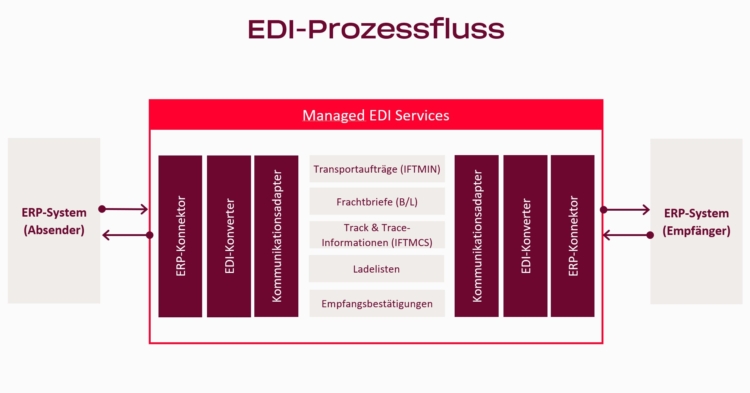
Our Managed EDI solution handles the secure exchange of your business documents. Orders, delivery notes and invoices are transferred automatically. Data flows across systems. And in real time.

You reduce effort. You minimize errors. This creates a digital foundation for stable and scalable processes.
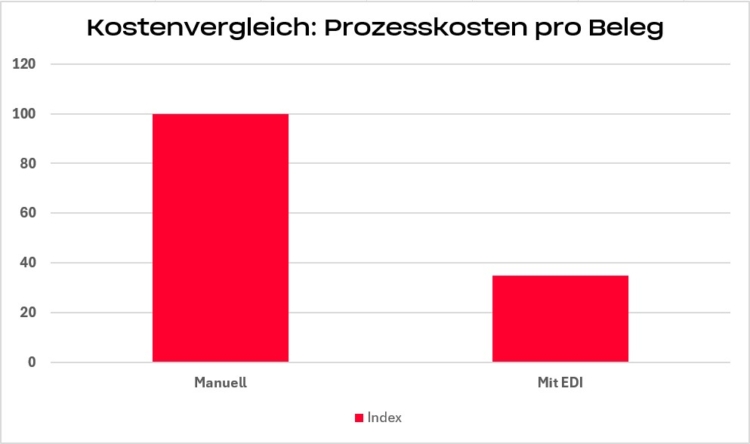
Efficiency calculable – Sustainable and predictable cost reduction

Manual data entry, error corrections, and separate system landscapes drive costs. Our EDI service automates these processes. You reduce the effort per document. And you reduce error and complaint costs.

At the same time, you avoid infrastructure investments. You get predictable service costs. And more budget control.

Service Partner – Plug-ins and Extensions.

As an SAP Service Partner, we strategically expand your SAP system with customs and foreign trade relevant functions. With solutions and services that work reliably.

Sanctions List Check

Check business partners, documents and HR master data automatically directly in SAP and block matches on relevant sanctions lists in an audit-proof manner.

Export Control

The solution automatically checks SD documents against your export control assessments, blocks matches with clear blocking reasons, documents each check completely, and manages your export authorizations in a structured way in the system.

Tariffication

Automate the assignment of commodity tariff numbers, monitor tariffed and untariffed materials, maintain findings-compliant descriptions, manage binding customs tariff numbers, and integrate the SOVA master data file via upload directly into your system.

Supplier Declaration Inbound

Inbound supplier declarations are created from bundled purchase data, requested and received declarations are monitored, and long-term supplier declarations can be extended in a structured manner.

Preference Calculation

Preference calculations are created from material master and sales document data, necessary purchase prices are determined from purchase orders or purchase info records, and all calculated preferences are continuously monitored.

Supplier Declaration Outbound

Sales data are bundled to create outbound supplier declarations, and created and sent declarations are continuously monitored.

Shipping

Deliveries and transports are automatically transferred to logistics service providers, freight goods including labels are packed, shipments are tracked via tracking & tracing, and all created shipping processes are continuously monitored.

Export

Export declarations are automatically created based on deliveries or invoices, standard routes and customs-specific parameters are configured, submission is automated, all export processes are monitored, and the export accompanying document is linked to delivery or invoice.

Import

Import and NCTS processes are carried out via customs declarations for free circulation (ATLAS), arrival notifications and compliance notifications for NCTS-ZE processes are created, and all import processes are continuously monitored.

Certificate of Arrival

Certificates of arrival for intra-community supplies are created from relevant documents such as deliveries, invoices or transports, sent, continuously monitored, and linked to the associated documents.

VAT ID

VAT identification numbers are automatically checked from SAP master and document data, blocked if invalid, and rechecked if internet services are unavailable.

Partnerships – Achieve more together.

OSIS

OSIS

We use OSIS (Open System Integration Server) from Logistische Systeme LS GmbH for EDI. With the platform-independent software, we can network various IT systems together. This allows us to cleanly integrate ERP, database, and business applications. The platform-independent software serves as the central data hub. This allows you to manage processes more efficiently. Increase security. And reduce operating costs.

ISO/IEC 27001

ISO/IEC 27001

The certification is an internationally recognized standard for information security management systems (ISMS). It provides us as an organization with a clear framework to plan, implement, monitor, and continuously improve information security. The standard defines what an ISMS must accomplish – from implementation through operation to continuous development.

Frequently Asked Questions (FAQ) – Explained briefly. Directly applicable.

What is EDI?

EDI stands for Electronic Data Interchange and refers to the automated exchange of business documents between companies in a standardized electronic format. Typical documents include, for example, orders, order confirmations, delivery notes, or invoices. EDI eliminates manual data entry, making processes faster, more secure, and more efficient.

What advantages does EDI offer for businesses?

EDI offers numerous advantages:

  • Time savings through automated processes
  • Fewer errors as manual data entry is eliminated
  • Faster business processes between partners
  • Cost savings through less paper and manual work
  • Better transparency in the supply chain

Many companies use EDI to digitalize and optimize their supply chain processes.

What documents are typically exchanged via EDI?

The most common EDI documents include:

  • Purchase orders
  • Order confirmations
  • Advance shipping notices
  • Invoices
  • Credit notes
  • Inventory and stock reports

These documents are transmitted using standardized formats such as EDIFACT, ANSI X12, or XML.

Is EDI only suitable for large enterprises?

No. While previously mainly large enterprises used EDI, today small and medium-sized enterprises (SMEs) can also benefit from EDI.
Modern cloud-based EDI solutions enable a quick start without extensive IT infrastructure or high investment costs.

How long does it take to implement an EDI solution?

The duration depends on several factors, for example:

  • Number of business partners to be connected
  • Data formats used
  • Integration into existing ERP systems

In many cases, an initial EDI connection can be implemented within a few weeks.

Managed EDI Service – Digital integration layer within the supply chain. Connects systems and all participants

Seamless Processes – Suitable Solutions. From a Single Source.

Learn more about complementary solutions from dbh. Well-thought-out. Comprehensive. Meaningful.

Advantage Customs
Advantage Customs
From A like registration to Z like customs warehouse. The ATLAS-certified software for customs and foreign trade is modularly expandable and fully integrable.
Advantage Compliance
The reliable Trade Compliance software that keeps you in control of regulations, sanctions, and export controls. For efficient and secure risk management.
Advantage Delivery
Advantage Delivery
The multi-carrier solution for your optimized shipping processes: Ship efficiently. Automate processes. Keep status transparent.
Fiduz
Fiduz
Manage air and sea freight centrally, reduce manual effort, avoid errors – keep all orders and processes in view across all clients.
ALPO
ALPO
With our software Advantage Logistics and Port Organisation – ALPO for short – you ensure efficient, secure and transparent handling of port orders.
Port Community System
Containers & Customs Status Port Communications Transshipment
Port Community System
One System. All Stakeholders. Connected Port Communication for Bremen, Bremerhaven, Cuxhaven and Wilhelmshaven.
PORTOS Videogate
PORTOS Videogate
License plate, wagon, and cargo data – automatically captured, verified, and forwarded directly to the terminal operations logistics applications.
PRINOS
Inland connectivity
PRINOS
System for planning, operational use, billing and statistical evaluation of port railway infrastructure. Provided for railway infrastructure companies. Seamlessly integrated with other port stakeholders.
PortServices
PortServices
Connect all stakeholders along your supply chain. For clear data, stable processes and more transparency in everyday operations.

Contact Sales – We'll help you move forward quickly.

Are you interested in our solutions or do you have a specific inquiry? Write to us. We’ll get back to you promptly with the next steps.

Your dedicated sales team
We'll get back to you quickly. We respond to written inquiries within 24 hours on weekdays.
Mon. through Fri., 8:00 a.m. to 5:00 p.m.